

13Jan
Saline Soaks: The Gold Standard for Piercing Healing Medical Science, Proper Ratios, and Why Sprays Fall Short
Why does salt water help wounds heal faster, while stronger antibacterial products can actually slow things down?
If you’ve ever been told to soak a piercing in salt water, you may have done it without knowing the reason. Salt water is gentle, affordable, and effective, but what makes it so helpful? And why do sprays, antiseptics, or stronger salt solutions sometimes slow healing?
The way our bodies repair wounds depends on their surroundings. Small changes in salt levels, moisture, or the length of exposure to solutions can affect inflammation, new tissue growth, and scarring. Years of research support this home remedy, which is also used in healthcare settings.
Next, we’ll discuss how your body heals wounds, detail the best saline ratios for healthy healing, and explain why soaking wounds in the right salt water is more effective than sprays or harsh treatments. If you want to understand why these care tips are recommended, this guide will provide clear, trustworthy answers.
1. The science of wound healing (the 4 classic phases)
Your body heals wounds in a very organized sequence:
1️⃣ Hemostasis (minutes–hours)
- Blood vessels constrict to slow blood loss.
- Platelets form a clot to stop bleeding.
- Fibrin creates a temporary “scaffold.”
Goal: Stop bleeding and seal the area.
2️⃣ Inflammation (hours–days)
- White blood cells (neutrophils, macrophages) flood into the area.
- They clear wound debris, bacteria, and damaged tissue.
- Redness, warmth, and swelling happen next.
Goal: Clean the wound and prevent infection
(This phase is necessary—but too much inflammation slows healing and can cause your jewelry to become too tight.)
3️⃣ Proliferation (days–weeks)
- New blood vessels grow (angiogenesis)
- Fibroblasts lay down collagen.
- New skin cells migrate across the wound.
- Granulation tissue forms (pink, bumpy tissue)
Goal: Rebuild the tissue structure.
4️⃣ Remodeling / Maturation (weeks–months)
- Collagen reorganizes and strengthens.
- Scar tissue refines and flattens.
Goal: Restore strength and function.
2. What wounds need to heal well
For optimal healing, a wound needs:
- Moist (not wet) environment
- Low bacterial load
- Proper oxygen supply and blood flow
- Balanced inflammation
- Cells are able to migrate freely.
To understand how these conditions are met, consider the role of saline in wound care.
3. Why salt water (saline) helps wounds heal
Not all saltwater is equal.
We’re talking about a gentle salt water—about 0.9% salt in water—which matches your body’s natural fluids, not the much saltier water you find in the ocean.
1. It’s isotonic to your cells
- is equivalent to the salt concentration of body fluids
- Does NOT damage cells
- Doesn’t pull water out of cells or swell them
Compare this to:
- Soaking in pure water can cause cells to burst (osmotic damage)
- Very salty water can dry out and harm healthy skin.
2. Reduces bacterial load (without killing tissue)
Salt water soaks:
- Flush bacteria and debris away from the wound
- It creates an unfriendly place for microbes.
- Helps your immune cells work more efficiently
Importantly:
- It does not sterilize (like peroxide or alcohol)
- It does not kill healthy cells the way harsh antiseptics do
This balance is essential.
3. Supports cell migration and tissue regeneration
Skin cells (keratinocytes) need:
- Moisture
- A stable chemical environment
- Tissue inflammation and irritation
Saline:
- Keeps wound surfaces hydrated
- Allows cells to slide and migrate across the wound bed
- Prevents scab formation, which actually slows healing
4. Calms excessive inflammation
- Salt water helps wash away inflammatory byproducts.
- Reduces swelling and tissue stress
- Helps wounds exit the inflammatory phase sooner
Less inflammation = faster progression to rebuilding.
5. Improves the nutrient flow and exchange
By:
- Removing debris
- Preventing thick crusts or dried exudate
Warm saline soaks keep the wound surface open and encourage the wound to drain, allowing:
- Better oxygen diffusion in the wound area
- Improved circulation to surrounding tissues
4. Why soaking works (when used correctly)
Short soaks:
- Rehydrate the tissue surrounding the piercing wound.
- Loosen crusts caused by wound drainage.
- Reduce pain and tightness around the jewelry.
But:
- Long or repeated soaking can overhydrate the area.
- If you water log the area (also called maceration), healing will slow. If the skin around the jewelry turns white immediately after your soak, you are soaking too long.
Best practice: use short, controlled soaks and proper wound management.
5. Why salt water beats peroxide, iodine, or alcohol
| Alcohol | Kills | Kills healthy cells |
| Hydrogen peroxide | Kills | Damages fibroblasts |
| Iodine | Kills | Cytotoxic |
|
Saline
|
Flushes | Preserves living tissue |
Modern wound care focuses on cell preservation, not just killing germs.
6. Why this matters for piercings, lacerations, and chronic wounds
Saline is ideal for:
- Piercings
- Surgical wounds
- Abrasions
- Minor burns
- Chronic wounds (ulcers, slow healers)
Because it:
- Respects biology
- Supports natural repair
- Minimizes scarring and infection risk
7. The takeaway (big picture)
Salt water doesn’t “heal” wounds directly—it creates the perfect conditions for your body to do what it already knows how to do.
Think of saline as:
“Clearing the stage, adjusting the lighting, and letting the performers work.”
Let’s clarify a major misconception about sprays versus soaks.
1. The exact saline ratio (isotonic, tissue-safe)
The goal is 0.9% sodium chloride, which most closely matches the composition of human extracellular fluid.
Recipe for a gold-standard home mixed saline solution
Ratio:
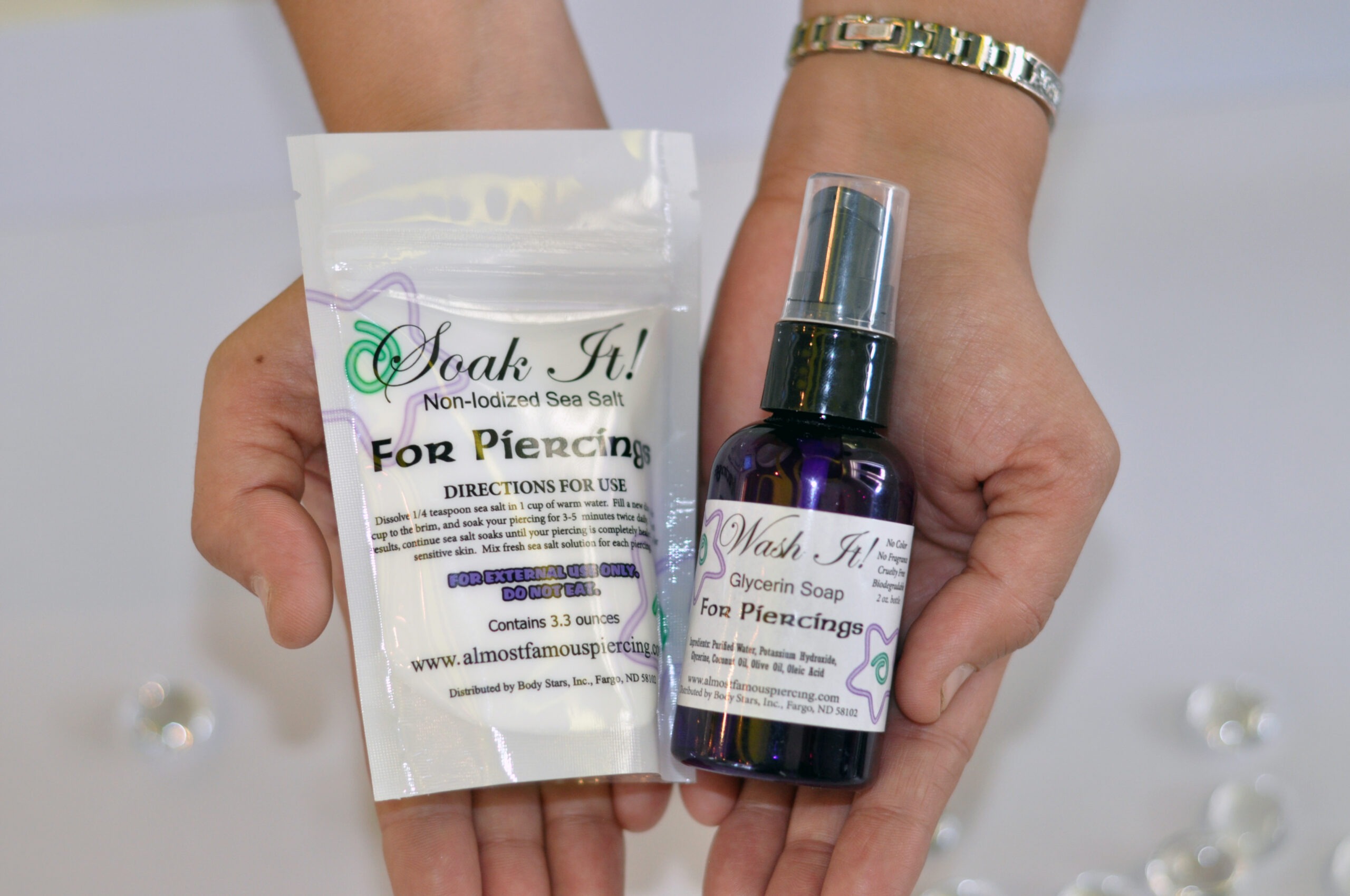
- ¼ teaspoon NON-iodized salt
- 1 cup (8 oz / 240 mL) clean water
This yields ~0.9% saline when measured correctly.
Important details that matter more than people think:
- It’s important to use non-iodized salt. Extra additives or iodine can make skin feel sore or uncomfortable.
- Fine-grain is better for accurate measuring.
- Use level, not heaping, ¼ tsp.
- Water should be:
-
- Distilled, sterile, or
- Boil for 5–10 minutes and cool.
If it stings, the solution is too salty—cells are being dehydrated.
2. Scaling the ratio (common amounts used at home)
| 1 cup (8 oz) | ¼ tsp |
| 2 cups (16 oz) | ½ tsp |
| 1 pint | ½ tsp |
| 1 quart (32 oz) | 1 tsp |
Never exceed 1 tsp per quart for wound care.
3. Why this ratio works biologically
At ~0.9%:
- No osmotic pull on cells
- Fibroblasts and keratinocytes survive.
- White blood cells remain functional.
- Collagen synthesis proceeds normally.
Higher concentrations:
- Dehydrate tissue
- Delay epithelial migration
- Increase inflammation
Slow healing (despite feeling effective)
4. Why are saline sprays less effective than soaking
Sprays aren’t useless—but they’re mechanically and biologically limited.
1. Contact time is too short
Healing processes need:
- Hydration
- Debris loosening
- Exudate dilution
Sprays:
- Wet the surface briefly.
- Evaporate quickly
- Do not rehydrate dried tissue.
Soaks:
- Maintain constant contact for 5–10 minutes.
- Actively soften crusts and dried lymph.
- Support deeper tissue hydration.
2. Sprays can’t flush debris effectively
A wound heals best when:
- Inflammatory byproducts are removed.
- Bacteria are diluted rather than crushed into tissue.
Sprays:
- Light surface rinse
- Often aerosolize bacteria rather than remove them.
Soaks:
- Allow gravity and diffusion to disperse debris.
- Reduce bacterial concentration gently.
3. Cell migration, continuous hydration, and moisture
Keratinocytes migrate across moist surfaces, not dry ones.
Sprays:
- Intermittent moisture
- Surface dries between applications.
Soaks:
- Create a temporary ideal migration environment.
- Reduce scab formation
- Speed epithelial closure
4. Store-bought sprays often aren’t truly isotonic
Even “sterile saline” sprays may include:
- Buffers
- Preservatives
- Higher salt concentration for shelf stability
- Pressurized delivery that does not increase circulation in the surrounding tissue
None are dangerous, but not ideal for healing.
5. Soaks reduce swelling more effectively
Soaks:
- Improve lymphatic drainage
- Reduce localized edema
- Relieve pressure pain
Sprays:
- Too brief to influence tissue pressure
5. When sprays are useful
Sprays are fine for:
- On-the-go cleaning
- Fresh wounds that don’t tolerate soaking
- Between proper soaks
- Initial debris removal
Think of sprays as maintenance, not treatment.
6. Best-practice soaking protocol
Frequency:
- 1–2× daily (early healing)
- Reduce as swelling resolves.
Duration:
- 5–10 minutes max
Aftercare:
- Pat dry with a clean paper towel.
- Allow airflow
- Do NOT re-spray immediately (overhydration slows healing)
7. Why “more salt” feels effective but isn’t
Hypertonic solutions:
- Draw fluid out of tissue.
- Temporarily reduce swelling
- Kill some bacteria
But they also:
- Damage healing cells
- Prolong inflammation
- Increase scar formation risk.
Comfort ≠ healing speed.
8. Bottom line
- ¼ tsp non-iodized salt per cup of water is the sweet spot
- Soaks outperform sprays because time + hydration = cell movement.
- Sprays are supportive but insufficient for wound healing.
- More salt slows healing, even if it “works” in the short term.
Why 0.9% saline is the biologically correct ratio
Claim supported:
Isotonic saline (0.9% NaCl) matches extracellular fluid, preserves fibroblasts and keratinocytes, and does not impair wound healing.
Citations:
- Lineweaver, W., et al.
Topical antimicrobial toxicity.
Archives of Surgery, 1985;120(3):267–270.
→ Demonstrates that solutions that differ from isotonic balance will damage fibroblasts critical for healing. - Khan, M. N., et al.
Comparison of isotonic saline and antiseptic solutions on wound healing.
Journal of Wound Care, 2011.
→ Confirms isotonic saline preserves cellular viability compared with antiseptics. - Guyton & Hall.
Textbook of Medical Physiology, 14th ed.
→ Establishes 0.9% NaCl as physiologically isotonic to plasma and interstitial fluid.
2. Why do higher salt concentrations slow healing
Claim supported:
Hypertonic solutions dehydrate tissue, impair epithelial migration, and prolong inflammation.
Citations:
- Winter, G. D.
Formation of the scab and the rate of epithelialization of superficial wounds.
Nature, 1962;193:293–294.
→ Shows epithelial migration is slowed in dry or osmotically stressed environments. - Atiyeh, B. S., et al.
Effect of moist and dry environments on wound healing.
Annals of Plastic Surgery, 2003.
→ Demonstrates dehydration and hypertonicity, delaying healing and increasing scarring. - Thomas, S.
Osmotic effects in wound care.
World Wide Wounds, 2001.
→ Explains why differences in solute concentration and tissue dehydration result from hypertonic solutions.
3. Why saline cleans without killing healing cells
Claim supported:
Saline reduces bacterial load via mechanical effects without cytotoxicity.
Citations:
- Cooper, M. L., et al.
Wound cleansing: a systematic review.
Journal of Advanced Nursing, 2013.
→ Finds saline effective for bacterial dilution without tissue toxicity. - Lawrence, J. C.
Wound irrigation.
Journal of Wound Care, 1997.
→ Identifies normal saline as the safest irrigant for preserving tissue viability.
4. Why soaking outperforms spraying
A. Contact time & hydration
Claim supported:
Sustained moisture enables keratinocyte migration and faster epithelial closure.
Citations:
- Svensjö, T., et al.
Moist environment and epithelial regeneration.
Scandinavian Journal of Plastic and Reconstructive Surgery, 2000. - Falanga, V.
Wound healing and its impairment.
The Lancet, 2005.
→ Identifies sustained moisture as critical for cell migration.
B. Debris removal & inflammatory control
Claim supported:
Soaking loosens necrotic debris and inflammatory exudate better than brief surface rinsing.
Citations:
- Rodeheaver, G. T., et al.
Wound cleansing by irrigation.
Surgical Gynecology & Obstetrics, 1975.
→ Demonstrates time-dependent debris removal effectiveness. - European Wound Management Association (EWMA).
Position Document: Wound Cleansing, 2013.
→ Recommends soaking/irrigation over brief spraying for chronic or crusted wounds.
5. Why sprays are less effective (but not useless)
Claim supported:
Intermittent surface wetting does not sustain the moisture gradients required for cell migration.
Citations:
- Cutting, K. F.
Wound cleansing: the evidence for saline.
Professional Nurse, 2000. - Bolton, L.
Moist wound healing: scientific principles.
Ostomy Wound Management, 2007.
6. Why are antiseptics slow to wound healing compared to saline
Claim supported:
Antiseptics kill bacteria and fibroblasts, delaying collagen synthesis.
Citations:
- Kramer, S. A.
Effect of povidone-iodine on wound healing.
Southern Medical Journal, 1999. - Wilson, J. R., et al.
Hydrogen peroxide cytotoxicity.
Journal of Bone and Joint Surgery, 1997.
7. Clinical guidelines supporting saline use
- World Health Organization (WHO).
Guidelines on wound care, 2016.
→ Recommends sterile saline or clean isotonic solutions for routine wound care. - Centers for Disease Control and Prevention (CDC).
Guideline for prevention of surgical site infection.
→ Identifies saline irrigation as standard practice.
Bottom line (evidence-based)
- ¼ tsp non-iodized salt per 8 oz water ≈ 0.9% saline → isotonic, tissue-safe
- Soaking works because cell migration, hydration, and debris removal are time-dependent biological processes
- Sprays help temporarily, but lack sustained contact.
- More salt does not equal faster healing (osmotic damage is scientifically documented)






Leave a Reply